Women’s Army Corps
September 1, 1939 – September 2, 1945
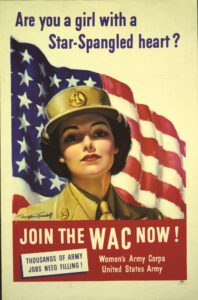
During World War II, the Women’s Army Corps (WAC) shattered long-standing military barriers and fundamentally transformed the role of women in the United States Armed Forces. Established initially as the Women’s Army Auxiliary Corps (WAAC) in May 1942 before officially becoming a part of the regular Army in 1943, the WAC was born out of an urgent wartime necessity to mobilize every available resource. Led by visionary director Oveta Culp Hobby, the corps answered the rallying cry of “freeing a man to fight” by enlisting hundreds of thousands of American women to take over non-combat military jobs both at home and abroad.
WACs served in an astonishing array of capacities that were vital to the Allied war effort. Operating far beyond traditional clerical roles, they worked as intelligence analysts, cryptographers, weather forecasters, postal workers, radio operators, and mechanics. They repaired heavy machinery, drove ambulances, and even piloted military aircraft in non-combat ferry missions. Deployed across multiple theaters of operation—including Europe, North Africa, and the Pacific—WACs often worked under grueling conditions and faced enemy fire, yet demonstrated exceptional resilience, discipline, and skill.
Despite their invaluable contributions, WACs frequently encountered skepticism, cultural resistance, and institutional sexism from male counterparts and the public alike, who struggled to reconcile military service with traditional gender roles. Nevertheless, their unwavering dedication and professionalism won the respect of military leadership, including General Dwight D. Eisenhower, who famously praised their efficiency and courage. The legacy of the Women’s Army Corps extends far beyond World War II; it permanently integrated women into the fabric of the U.S. military, paving the way for future generations to serve in all branches and combat roles on an equal footing.