Census Records
The United States Census records are a systematic series of population counts and detailed questionnaires that the federal government has conducted every ten years since 1790. Each decennial census begins with a door‑to‑door enumeration in which enumerators record the name, age, sex, race, marital status, relationship to the head of household, and place of birth of every person living in a dwelling. Over time the questionnaire has expanded to capture additional socioeconomic data—such as occupation, property ownership, literacy, and, in the 20th‑century “long form,” information on school attendance, migration patterns, and veteran status. Because the census is mandated by the Constitution and funded by Congress, it provides a remarkably continuous, nationwide snapshot of American society, making it an indispensable resource for historians, demographers, and genealogists alike.


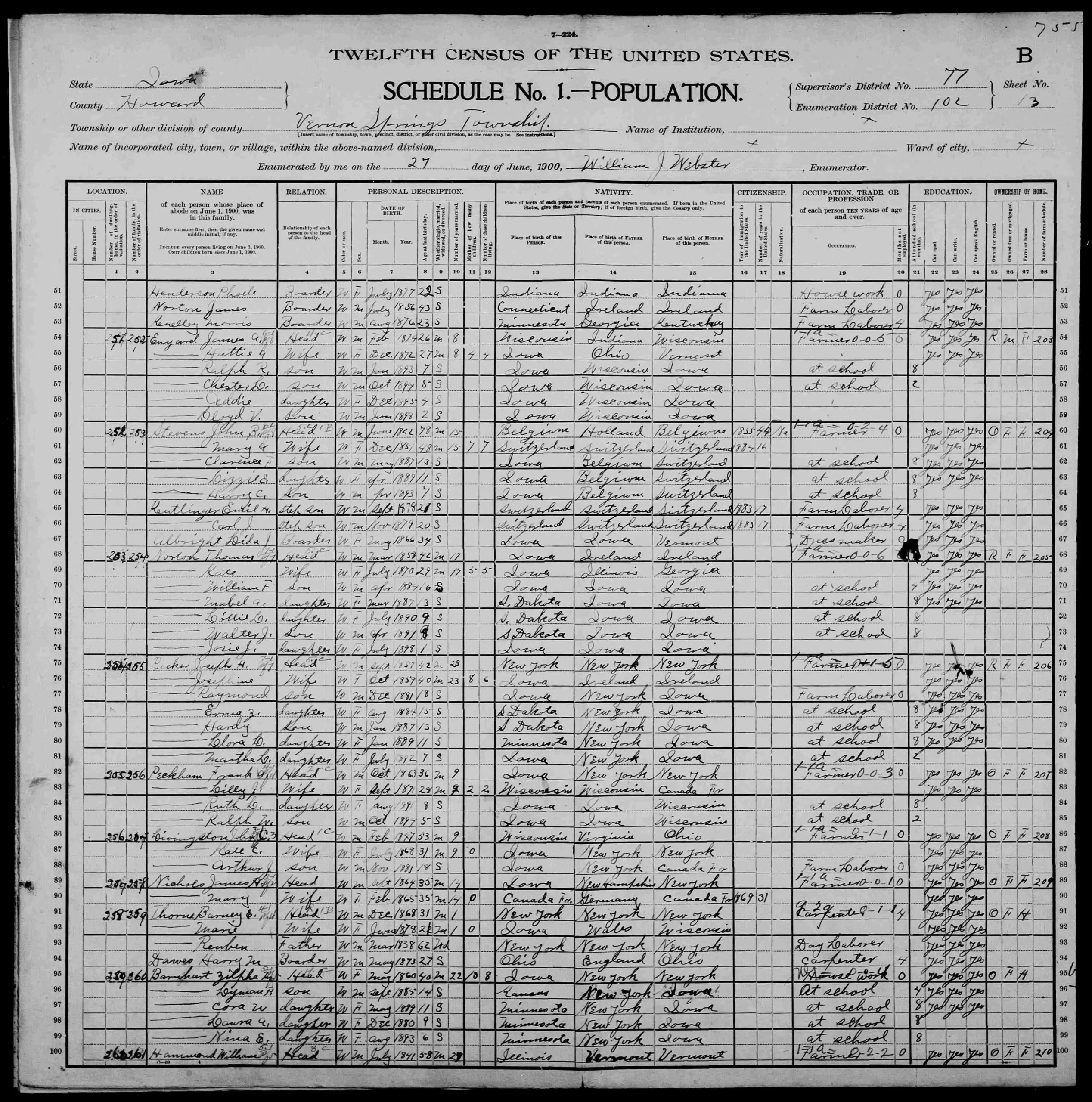


U.S. Census Records for Wisconsin: A Genealogical and Historical Treasure Trove
Since its admission to the Union in 1848, Wisconsin has been documented in every decennial federal census, providing a rich, longitudinal portrait of the state’s people, farms, and industries. The most frequently consulted records are the population schedules (1790‑1930, with the 1940 schedule now fully digitized and the 1950 schedule recently released), which list every resident of a household, their age, sex, race, birthplace, occupation, and relationship to the head of family. These schedules capture the state’s early settlement patterns—rural German, Norwegian, and Irish enclaves in the western counties, the burgeoning German‑American communities of Milwaukee, and the mining towns of the Upper Peninsula’s border region—allowing researchers to trace family movements from the territorial censuses of 1830, 1840, and 1850 (the latter two of which are partially reconstructed from a combination of original schedules and later‑published abstracts).
Beyond head‑counts, Wisconsin’s censuses include a series of special schedules that illuminate everyday life. The Agricultural Census (starting in 1850 and published every ten years) enumerates farm size, crop yields, livestock numbers, and the value of equipment, offering a granular view of the state’s transformation from frontier subsistence farms to the dairy powerhouse it became by the early 20th century. The Manufacturing and Commercial Schedules (also begun in 1850 and retained through 1940) list factories, merchants, and service providers, detailing the rise of Milwaukee’s brewing and meat‑packing industries, the lumber mills of the Northwoods, and the growth of rail‑dependent towns like Green Bay and La Crosse.
All of these records are now widely accessible: digitized images and searchable transcriptions reside on the National Archives’ Access to Archival Databases (AAD), FamilySearch, Ancestry.com, and the Wisconsin Historical Society’s digital collections. Researchers can also consult microfilm copies at local libraries, courthouses, and the state’s Genealogy Centers. Because Wisconsin’s census data often include state‑specific notations—such as the “Native American” designation that appears only in the 1900 and 1910 schedules for the Menominee and other tribes—these records are indispensable for both family historians and scholars studying demographic, economic, and cultural shifts in the Upper Midwest. In short, the U.S. Census documents for Wisconsin provide a multi‑dimensional, decade‑by‑decade snapshot of a state that evolved from a frontier territory into a diverse, industrious community, making them an essential resource for anyone seeking to understand the people and places that shaped Wisconsin’s past.
Genealogy (from Greek: γενεαλογία genealogia from γενεά genea, “generation” and λόγος logos, “knowledge”), also known as family history, is the study of families and the tracing of their lineages and history.